
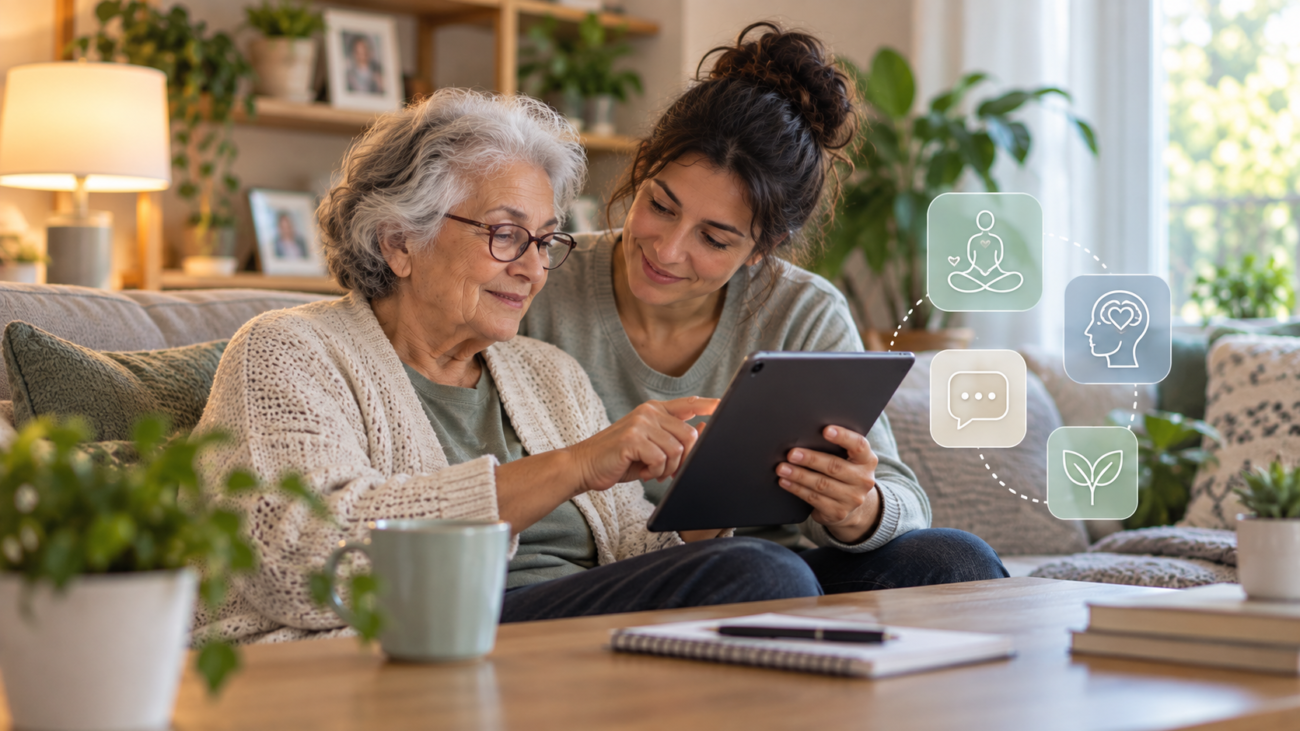
Home care plays an important role in helping older adults receive support while remaining in familiar surroundings.
For many individuals and families, receiving care at home can help maintain routines, independence, and connection to the community. Home care professionals may provide personal support, companionship, nursing services, assistance with daily activities, or other forms of care depending on an individual’s needs.
But home care also presents a unique challenge.
A caregiver may spend several hours with an older adult and then leave. A family member may visit later in the week. Another professional may arrive on a different day.
Each person sees part of the individual’s life, but no one necessarily sees the entire picture.
Digital mental wellness tools may help provide greater continuity between these interactions by making regular check-ins and changes over time easier to observe.
The Visibility Gap in Home Care
Imagine an older adult receiving home care three times a week.
A caregiver visits Monday morning. Another visit takes place Wednesday afternoon. A family member stops by on Saturday.
During those interactions, everyone may ask questions, observe how the individual is doing, and provide support.
But what happens between those visits?
Perhaps sleep begins to change.
Energy gradually decreases.
The individual participates less in activities they normally enjoy.
Their mood feels slightly different.
None of these changes may be dramatic enough to immediately attract attention. And because different people interact with the individual at different times, each person may see only one small part of the pattern.
This creates a potential visibility gap.
Digital wellness monitoring cannot eliminate that gap entirely, but it may help create greater continuity.
Why Mental Wellness Matters in Home Care
Home care is often associated with physical needs: mobility, medication support, meals, hygiene, safety, and daily activities.
These are essential components of care.
But overall well-being includes more than physical health.
Mood, sleep, energy, motivation, social connection, stress, and engagement can all influence how someone experiences daily life.
For older adults, changes in these areas may develop gradually.
That means mental wellness awareness can be an important complement to the other observations already being made by families and care professionals.
The goal is not to transform home care professionals into mental health diagnosticians.
Instead, it is to provide additional awareness of changes that may be worth discussing.
Why Occasional Conversations May Not Show the Whole Picture
Asking someone how they feel is valuable.
But the answer represents one point in time.
An older adult may feel particularly good during a caregiver’s visit even though the previous several days were difficult.
The opposite can also happen.
Someone may have one unusually difficult morning despite generally feeling well throughout the week.
Without consistent observations, it can be difficult to distinguish a temporary fluctuation from a developing pattern.
Regular check-ins can provide additional context.
Instead of relying entirely on isolated conversations, repeated observations may help create a more continuous picture of well-being.
Simple Check-Ins Can Create Useful Context
Digital mental wellness monitoring does not need to involve complicated questionnaires or lengthy assessments.
In home care environments, simplicity may actually be one of the most important design requirements.
Short, accessible check-ins can encourage individuals to reflect on aspects of their daily well-being, such as:
- Mood
- Sleep
- Energy
- Stress
- Motivation
- Daily engagement
- Social interaction
- General sense of well-being
One response alone may not provide much information.
The value becomes clearer when responses are viewed over time.
If an individual’s mood, sleep, and energy remain relatively stable, that creates one picture.
If several areas gradually begin changing, that creates another.
The technology does not need to decide what those changes mean in order to be useful.
Simply making them more visible can support better awareness.
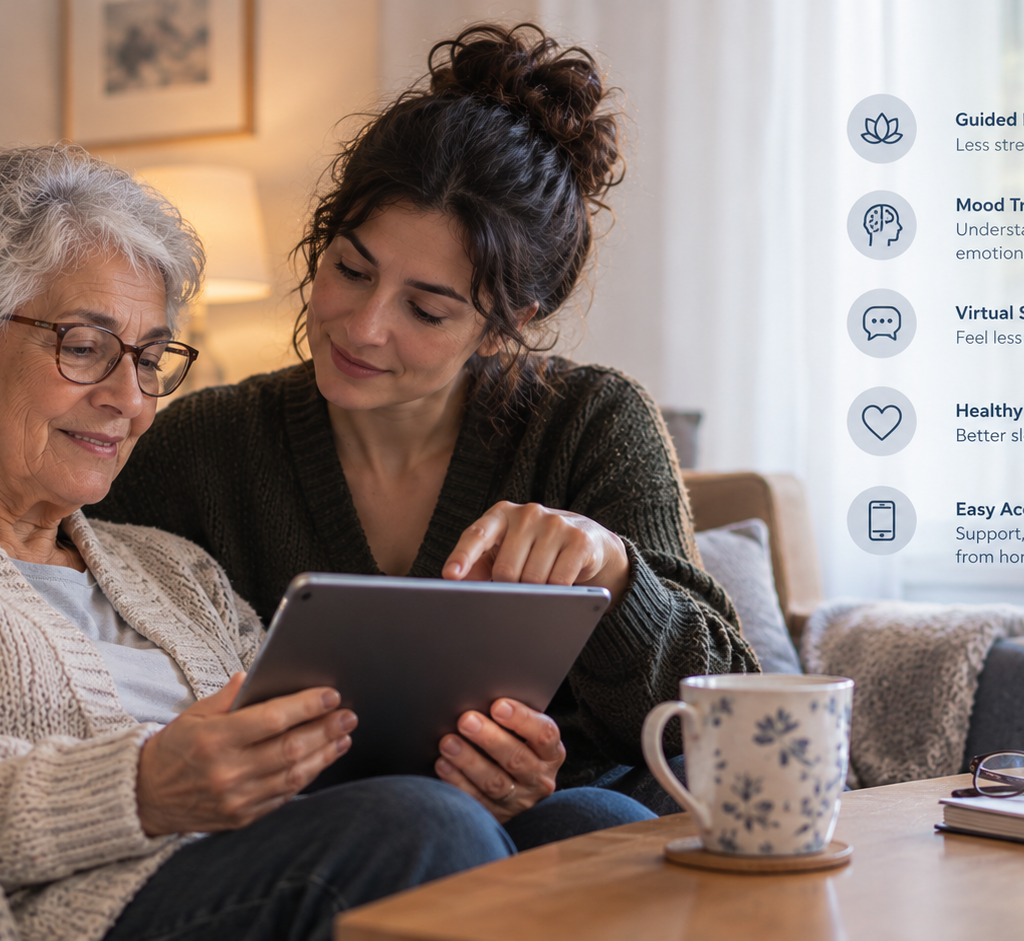
Supporting Families Between Visits
Family members often play an important role in home care.
However, many families face practical limitations.
Adult children may live in another part of the city, another province, or even another country. Work and family responsibilities can make frequent visits difficult.
This can create uncertainty.
“How has Mom really been doing this week?”
“Has Dad been sleeping better?”
“Has anything changed since my last visit?”
Digital wellness tools may provide another layer of information that complements phone calls, visits, and caregiver observations.
This should not become a substitute for personal connection.
A dashboard cannot replace a conversation with a parent.
But better awareness can help families know what questions may be worth asking.
Technology is most valuable when it leads back to meaningful human interaction.
Supporting Home Care Professionals
Home care professionals already collect and process significant amounts of information during their work.
Any new technology introduced into this environment should therefore reduce friction rather than create more of it.
A useful mental wellness tool should not require caregivers to spend excessive time entering information or navigating complicated systems.
Instead, digital tools can potentially support care teams by making patterns easier to recognize and providing additional context around an individual’s everyday well-being.
For example, if regular check-ins show a noticeable change over time, that information may help a care professional begin a more focused conversation.
The tool provides awareness.
The caregiver provides human understanding and professional judgment.
From Reactive Care to Proactive Awareness
Many changes become visible only after they begin significantly affecting daily life.
At that point, families or care teams naturally respond.
Regular wellness monitoring introduces another possibility: noticing patterns earlier.
This does not mean predicting medical conditions or diagnosing mental health concerns.
It means recognizing that something appears different from the individual’s usual pattern.
That distinction matters.
A digital wellness tool might help identify that reported sleep, energy, or mood has changed over several weeks.
It cannot independently determine why.
But greater awareness can encourage families, caregivers, or healthcare professionals to ask appropriate questions sooner.
That is the difference between trying to automate care and using technology to support more proactive awareness.
Technology Should Strengthen Human Care
The future of home care should not be framed as a choice between people and technology.
They perform fundamentally different roles.
Human caregivers provide empathy, observation, experience, conversation, reassurance, and personal connection.
Technology can provide consistency, organization, and the ability to observe information across time.
Used thoughtfully, the two can complement each other.
A digital tool can remember that someone’s reported energy has gradually declined over three weeks.
A caregiver can sit beside that person and ask:
“How have you been feeling lately?”
That conversation is where technology and human care meet.
The goal should always be to strengthen care, not replace the people providing it.
Making Technology Accessible for Older Adults
Digital health technology is only useful when people can actually use it.
This is especially important when designing solutions for older adults.
Complicated interfaces, excessive steps, small text, unclear instructions, or lengthy questionnaires can create unnecessary barriers.
Digital wellness tools intended for senior care should prioritize simplicity and accessibility.
Interactions should be understandable.
Check-ins should be manageable.
The technology should fit into someone’s routine rather than requiring their routine to revolve around the technology.
This principle is central to making digital mental wellness monitoring practical in real-world care environments.
How Mentaligence Fits Into Home Care
Mentaligence is designed around simple, consistent mental wellness check-ins that help create greater visibility into changes over time.
Rather than relying entirely on occasional snapshots, the platform aims to help users build a broader picture of mental wellness patterns.
For an older adult receiving home care, this may provide another opportunity to reflect regularly on their well-being.
For families, it can support greater awareness between visits.
For care teams, it may provide additional context that complements direct observation and human interaction.
The objective is not to add another complicated layer to care.
It is to make important changes easier to see.
Privacy and Trust Matter
Mental wellness information is personal.
Any organization considering digital wellness technology should therefore think carefully about privacy, security, consent, and appropriate access to information.
Older adults should understand what information is being collected and how it may be used.
Organizations should also consider who needs access to wellness information and how digital tools fit within their existing privacy and information-management responsibilities.
Trust is especially important in health-related technology.
A digital tool can only provide meaningful value when users feel comfortable engaging with it.
Digital Monitoring Has Limits
Mental wellness technology should not be treated as a substitute for medical or mental health care.
Changes in mood, sleep, energy, behavior, or daily functioning can have many possible explanations.
A digital platform cannot independently understand all of those factors.
If an older adult experiences significant, persistent, sudden, or concerning changes, appropriate healthcare professionals should be consulted.
The role of digital wellness monitoring is to support awareness and provide additional context, not to independently diagnose or treat health conditions.
A More Connected Approach to Home Care
Home care involves many individual moments.
A caregiver arrives.
A family member calls.
A nurse visits.
An older adult goes through the rest of their day.
Digital wellness monitoring has the potential to create a thread between some of those moments.
That thread does not replace human relationships.
It can simply help make changes easier to recognize.
As home care continues to evolve, the most valuable technologies may not be those that attempt to automate everything.
They may be the technologies that quietly help people provide better human care.
Simple check-ins. Greater awareness. More informed conversations.
Explore Mentaligence for Your Organization
Mentaligence is developing a simple approach to digital mental wellness monitoring designed to support individuals, families, caregivers, and care organizations.
We are exploring pilot partnerships with home care providers, senior living communities, healthcare organizations, and other organizations supporting older adults.
Pilot partnerships can provide an opportunity to evaluate how regular mental wellness check-ins may fit into existing care workflows while also generating valuable real-world feedback for continued product development.
Interested in exploring a Mentaligence pilot for your organization? Contact us to learn more.